Gas charged struts are renowned mechanical components frequently utilised in the automotive sector, alongside in furniture, medical apparatuses, and other scenarios where a refined, regulated movement of a mechanical element is sought after. Learn more about gas charged struts and use our online tools to find the perfect gas struts for your application.
What are gas struts?
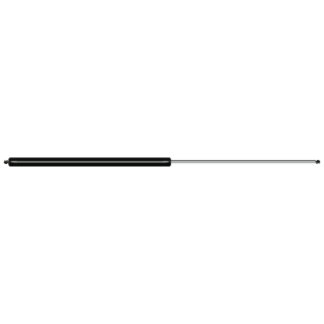
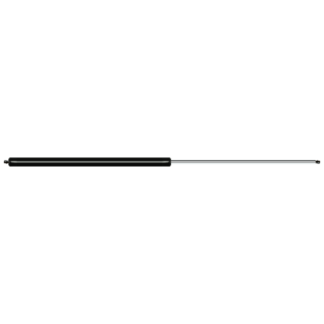
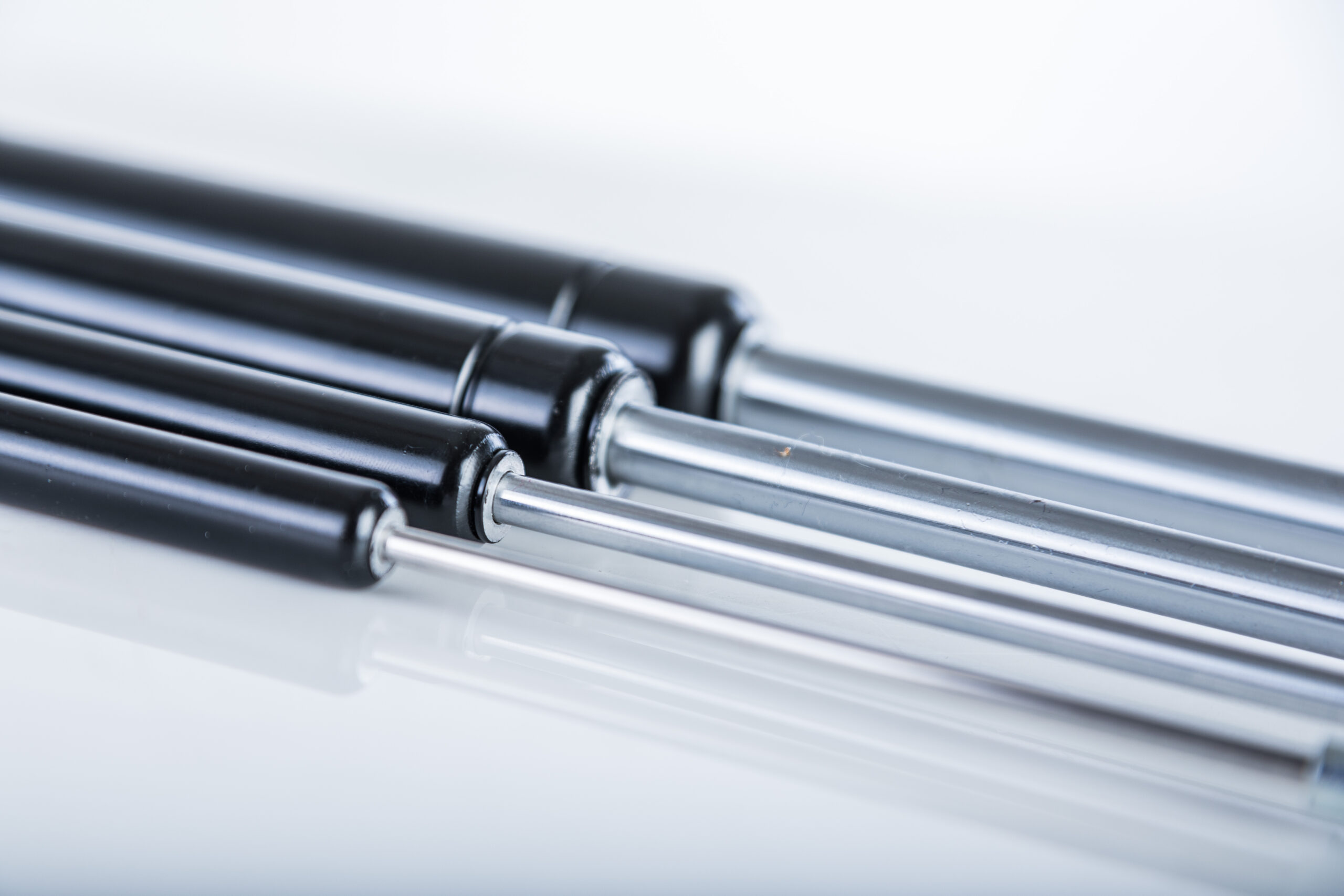
Gas charged struts, also known as gas springs or gas dampers, are mechanical devices used in various applications to provide controlled motion and support. They consist of a piston enclosed within a cylinder filled with compressed gas, typically nitrogen. When force is applied, such as when opening or closing a door or hatch, the piston moves within the cylinder, compressing the gas and creating resistance. This resistance helps to slow down the motion, providing a smooth and controlled movement. Gas charged struts are commonly found in automotive hoods, tailgates, furniture, and industrial machinery, where they offer reliable support and damping capabilities.
Discover the applications
Gas charged struts have a wide array of applications across various industries, owing to their ability to provide controlled damping and support in mechanical systems. In automotive engineering, they are commonly employed in vehicle suspension systems to absorb shocks and maintain stability, enhancing ride comfort and handling. In aerospace, gas charged struts play a crucial role in landing gear assemblies, ensuring smooth touchdown and weight distribution during aircraft landings. Furthermore, they find use in industrial machinery such as adjustable ergonomic chairs, medical equipment like hospital beds for smooth height adjustment, and even in furniture design to facilitate smooth opening and closing of cabinets and doors. The versatility and reliability of gas charged struts make them indispensable components in numerous mechanical applications, where precise control of motion and support is essential.
10 advantages of gas charged struts
- Smooth operation: Gas charged struts provide a smooth and controlled motion, making them ideal for various applications such as automotive hoods, furniture, and industrial machinery.
- Adjustability: Gas springs can be easily adjusted to suit specific requirements, allowing for precise control over the force applied and the speed of movement.
- Space efficiency: Gas struts take up minimal space compared to other types of mechanical springs, making them suitable for applications where space is limited.
- Durability: Gas springs are typically constructed from high-quality materials such as stainless steel, ensuring durability and longevity even in harsh environments.
- Safety: Gas struts are designed to operate safely, with built-in features such as overload protection and damping to prevent sudden movements and accidents.
- Versatility: Gas springs can be used in a wide range of applications, from automotive and aerospace to furniture and medical equipment, due to their adaptability and versatility.
- Quiet operation: Gas charged struts operate quietly without the noise associated with other types of mechanical springs, making them suitable for use in environments where noise levels need to be minimised.
- Maintenance-free: Once installed, gas springs typically require minimal maintenance, reducing downtime and operational costs over their lifespan.
- Customisation: Gas struts can be customised to meet specific requirements, including variations in size, force, and mounting options, providing flexibility in design and application.
- Energy efficiency: Gas springs operate using compressed gas, which can be stored and released efficiently, making them an energy-efficient choice compared to hydraulic systems or traditional mechanical struts.
Use our online tools
It’s crucial to accurately compute the installation of gas charged struts. Subject to the application, gas struts embody a safety precaution. Merely surmising the fitting position, gas strut dimensions, material & requisite force in newtons is ill-advised. Fortunately, we’ve streamlined the process of purchasing and mounting gas charged struts! We’ve devised several complimentary online tools to assist you in computing, personalising, or supplanting struts.
Replace your existing gas charged struts
If you’re on the hunt to substitute your gas struts, you’re in luck. On our website, you’ll come across a dedicated replacement tool. This user-friendly instrument lets you input a portion or the full article number, post which the tool endeavours to identify a direct match. Should one be available, a suitable replacement gas strut will be displayed.
Give our replacement tool a whirl.
Determine a gas charged strut application
As emphasised earlier, a precise determination of gas strut applications holds paramount significance concerning user safety. Naturally, haphazardly selecting and ordering a gas strut isn’t the recommended course of action.
Thankfully, there’s no need for dubious calculation sheets or excessive pondering. We’ve pioneered a no-cost calculator tool, featuring an interactive layout, permitting you to key in all vital metrics and model the application.
Explore our calculator tool.
Solely for the adept – personalise gas struts
Fancy yourself as a connoisseur in the gas strut domain? This instrument will undoubtedly resonate with you. Our third complimentary online resource facilitates the customisation of your gas charged struts, allowing switches between mounting components, strut sizes, materials, and subsequently determining the precise force in newtons required.
The interactive platform instantaneously reflects alterations and offers a 3D visualisation of your configuration. Once content with the outcome, seamlessly add to your basket and proceed with your order.
Craft your unique gas struts here.
Unresolved questions?
Should any questions remain, please don’t hesitate to engage with our support team via our contact form. For pressing concerns or business-related dialogues, please ring us at +44(0)24 7645 5580. Alternatively, utilise our search functionality located in the website’s top right corner to peruse specific subjects. For email correspondence, reach us at [email protected].